


How to Select the Right Electrical Cable for Your Installation
When designing a building’s electrical infrastructure, no matter how high-quality the switches, sockets, and distribution boards are, the system is only as safe as the conductors carrying the power. Hidden behind walls, plasters, and conduit routes, cables serve as the vital arteries of any electrical system.
Choosing an incorrect electrical cable size or using conductors with insufficient current-carrying capacity leads to overheating over time, melted insulation, short circuits, and ultimately severe electrical building fires. In this guide, we will cover the logic behind cable size calculations, the key differences between common cable types, and where to deploy NYM versus halogen-free NHXMH cables for a safe installation.
Why Cable Size Calculation Matters in Electrical Systems
The safe amount of current an electrical wire can transport depends directly on its cross-sectional area (measured in mm²). Just as a larger water pipe accommodates a greater volume of water without bursting, a thicker copper conductor carries a higher electrical current (Amperage) safely without overheating.
Cable size calculation is governed by two core engineering metrics:
-
Current-Carrying Capacity: The total power demand (in Watts) of all connected appliances (ovens, air conditioners, heaters, etc.) is calculated to determine the required current draw. The selected cable cross-section must be rated to carry this continuous load without thermal degradation.
-
Voltage Drop: As the physical distance between the distribution panel and the end-use device increases, voltage losses occur along the line. If the circuit path is long, the cable size must be stepped up to a larger cross-section to prevent equipment damage caused by undervoltage.
Standard Cable Sizes in Residential Installations:
-
Lighting Circuits: Switches and light fixtures are typically wired using 1.5 mm² solid copper conductors.
-
Standard Socket Circuits: General-purpose wall outlets require a minimum cross-section of 2.5 mm².
-
High-Power Appliance Circuits (Dedicated Lines): Heavy-draw appliances such as air conditioners, electric ovens, water heaters, and dishwashers must be fed by dedicated lines running directly from the main breaker panel, using 4 mm² or 6 mm² cables depending on their rated wattage.
Common Cable Types: NYM vs. NHXMH
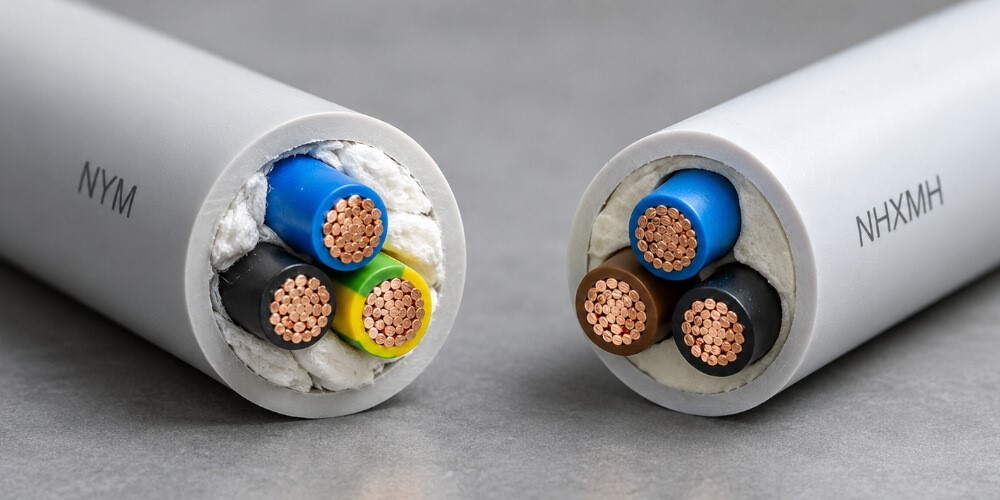
Building wiring conductors are categorized by their sheath construction, insulation materials, and fire-performance characteristics. The two most widely used installation cable types in modern construction projects are NYM and NHXMH.
1. What is an NYM Cable?
NYM cables feature solid or stranded copper conductors insulated with PVC and wrapped in a protective PVC outer sheath.
-
Key Characteristics: Highly flexible and easy to strip, NYM cables can be installed above or below plaster inside conduits, as well as in damp or wet indoor locations. Their tough outer sheath provides robust resistance against moisture and light mechanical stress.
-
Application Areas: Residential homes, dry and damp interior spaces, basements, and standard commercial buildings.
2. What is an NHXMH Cable? (Halogen-Free / Flame-Retardant)
While structural layouts are like NYM, NHXMH cables utilize fundamentally different jacketing materials. The outer sheath is composed of cross-linked, halogen-free, flame-retardant polymers.
-
Key Characteristics: In the event of a fire, NHXMH cables do not propagate flames, are self-extinguishing, and release zero toxic chlorine gas. Crucially, they emit minimal, non-dense smoke, keeping evacuation corridors visible.
-
Application Areas: Building codes make halogen-free cabling legally mandatory in high-density public spaces such as hospitals, schools, shopping malls, hotels, airports, and high-rise commercial towers.
Golden Rules for Safe Cable Selection
To establish a resilient, secure electrical infrastructure, always adhere to these vital selection standards:
-
Verified Quality Standards (CE & IEC): Ensure the cables comply with international standards (such as IEC 60228 / EN 60228) and use high-purity electrolytic copper. Substandard copper-clad aluminum (CCA) cables drastically increase electrical resistance, causing intense heat buildup and fire hazards.
-
Operating Temperature and Environment: If cable routes pass through areas exposed to high temperatures, industrial chemicals, or direct sunlight (UV rays), select specialized heavy-duty sheathing rated for those specific environmental stresses.
-
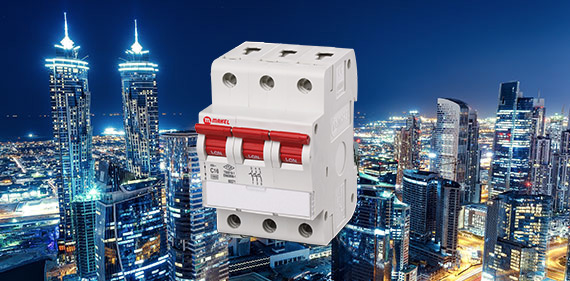
Breaker Coordination: The current rating of the protective Miniature Circuit Breaker (MCB) must strictly match the load capacity of the connected cable size. For example, a 1.5 mm² lighting cable should be protected by a 10A breaker, while a 2.5 mm² socket line should be paired with a maximum 16A breaker. Oversizing the breaker prevents it from tripping when the cable overheats and melts.
Build Your System on the Right Foundation
Cable selection in electrical installations is never an area to cut costs. Ensuring accurate load calculations, specifying correct cross-sectional wire sizes, and mandating halogen-free NHXMH cabling in public and commercial spaces are vital to protecting lives and property. Paired with reliable low-voltage switchgear, a properly sized wiring network ensures your building operates safely for decades.