


Single-Phase vs. Three-Phase Power: Core Differences Explained
When designing the electrical infrastructure of a residential property, commercial building, or manufacturing facility, the earliest fundamental engineering decision is determining the supply phase configuration. The electrical characteristics delivered by the grid dictate everything that follows—from the machinery you can operate to cable sizing, circuit breaker selection, and electricity metering hardware.
What exactly is single-phase power, what is three-phase power, and what are the functional differences between single-phase and three-phase systems? In this technical guide, we break down operating principles, voltage ratings, power delivery capacities, and critical criteria for selecting the right electronic electricity meters.
What is Single-Phase Power? (Monophase)
Single-phase power is an alternating current (AC) electrical distribution system where voltage varies concurrently across a single alternating wave.
Key operational characteristics include:
-
Conductor Configuration: The wiring network typically consists of two primary conductors: one live Phase conductor carrying the alternating current and one Neutral conductor completing the loop back to the transformer (accompanied by a dedicated protective Earth/Ground wire for human safety).
-
Nominal Voltage: Voltage is measured between Phase and Neutral, delivering a nominal 230V (standard throughout Europe and many global regions, historically referenced as 220V) at a frequency of 50 Hz or 60 Hz.
-
Primary Application Areas: Ideal for standard household appliances (televisions, refrigerators, washing machines, small kitchen equipment) and basic lighting circuits across residential apartments, small private offices, and light retail spaces.
What is Three-Phase Power? (Triphase)
Three-phase power is a polyphase electrical distribution system delivering three separate alternating currents through the same circuit, with each sine wave displaced by an electrical angle of 120 degrees (one-third of a cycle).
Core attributes of three-phase networks include:
-
Conductor Configuration: The circuit utilizes three separate Phase conductors (L1, L2, L3) and a shared Neutral conductor, supported by a protective Earth conductor.
-
Dual Voltage Capability: When measuring voltage between any two active phases (Line-to-Line: L1-L2, L2-L3, or L1-L3), the system delivers nominal 400V (historically 380V). When measuring between any single phase and the neutral conductor (Line-to-Neutral), it yields the standard 230V.
-
Constant Power Transfer: Because the three AC sine waves reach their peaks at alternating intervals, the total instantaneous power delivered to the circuit never drops to zero. This continuous power flow enables heavy industrial electric motors to start reliably under load, deliver steady torque, and operate with superior efficiency without mechanical vibration.
Key Differences: Single-Phase vs. Three-Phase
To specify the correct electrical setup for a project, compare both systems across core technical parameters:
|
Parameter |
Single-Phase (Monophase) |
Three-Phase (Triphase) |
|
Conductors |
1 Phase + 1 Neutral (+ Earth) |
3 Phases + 1 Neutral (+ Earth) |
|
Nominal Voltage |
230V (Phase-to-Neutral) |
400V (Line-to-Line) / 230V (Line-to-Neutral) |
|
Power Capacity |
Low to medium loads (Typically 10 kW) |
High to massive loads (10 kW to Megawatts) |
|
Cabling & Hardware Costs |
Lower wiring complexity and single-pole switchgear |
Multi-pole breakers, larger panels, higher initial cost |
|
Motor Performance |
Lower efficiency, requires start/run capacitors |
High efficiency, self-starting, smooth rotational torque |
|
Standard Use Cases |
Homes, private apartments, standard wall outlets |
Industrial plants, workshops, elevators, commercial HVAC |
Why Homes Use Single-Phase While Industry Demands Three-Phase
Residential dwellings exhibit lower instantaneous electrical demand. Lighting arrays, entertainment devices, and standard appliances run smoothly on a 230V line. Keeping domestic distribution single-phase minimizes switchgear footprint, simplifies breaker panels, and optimizes cable installation costs.
In contrast, commercial and industrial sites rely on equipment such as CNC milling centers, large air compressors, cooling towers, freight elevators, and heavy pumping arrays. Attempting to run high-load machinery on a single-phase supply would draw excessive currents, necessitating massive copper conductors, causing steep voltage drops, and incurring parasitic heat losses along distribution runs. Three-phase electricity delivers significantly greater power using lower currents and thinner copper cross-sections, maximizing energy efficiency across heavy-duty circuits.
Selecting the Right Electricity Meter
Accurately tracking power usage and maintaining legal compliance requires installing an energy meter specifically designed for your supply configuration:
-
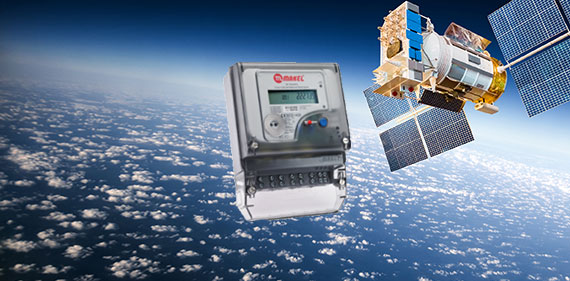
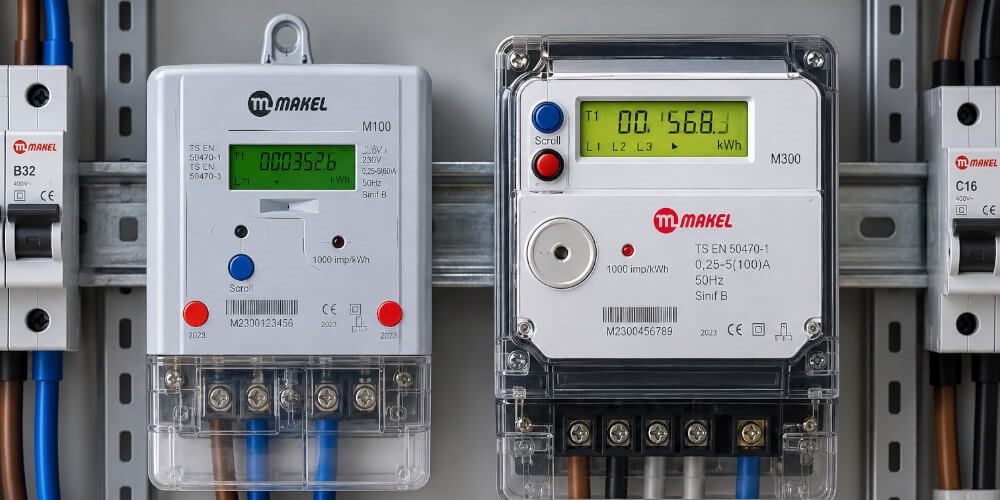
Single-Phase Meters: Compact units engineered to measure active energy consumption across single-phase residential and commercial utility connections.
-
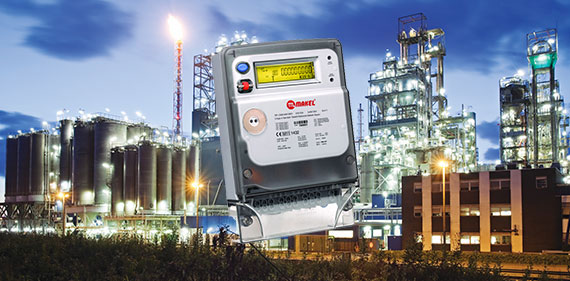
Three-Phase Meters: Advanced measurement devices designed to monitor active and reactive energy simultaneously across all three phases, recording voltage quality, current profiles, and peak demand data.
For precision billing, smart grid telemetry, and compliance with strict MID (Measuring Instruments Directive) standards, explore Makel's meters range.
Aligning Infrastructure with Power Demands
Deciding between single-phase and three-phase power is governed by connected load requirements and machinery specifications. Single-phase systems offer cost-effective, straightforward power distribution for everyday domestic living, while three-phase networks provide the power density, torque stability, and transmission efficiency required by modern commercial and industrial facilities. Selecting durable cables, certified switchgear, and precision electronic meters ensures an electrical installation runs efficiently and safely for years to come.