





What is a Residual Current Device? Home Electrical Safety Guide

While electrical energy is an indispensable pillar of modern infrastructure and convenience, it poses lethal hazards if left unmonitored. The standard circuit breakers mounted in residential or commercial distribution boards are designed exclusively to protect wiring insulation and connected appliances from massive overcurrent or severe short circuits. However, if a human body makes direct contact with a frayed, live wire, a classic circuit breaker cannot detect this immediate threat to life.
The primary line of defense protecting human lives and property from catastrophic shocks and electrical fires is the residual current device (commonly known as an RCD or RCCB). In this technical guide, we will analyze what an RCD means, unpack its fundamental working principle, and establish the correct selection criteria to ensure maximum electrical safety for your infrastructure in 2026.
How Does a Residual Current Device Work?
A residual current circuit breaker is a highly sensitive electrical safety mechanism engineered to continuously measure and compare the current flowing into a circuit against the current flowing back out.
The internal operational logic operates like a perfectly balanced scale:
- Under healthy, normal conditions, the current arriving from the grid via the Phase (Live) conductor must be exactly equal to the current returning through the Neutral conductor to complete the loop.
- If an insulation breakdown occurs, an appliance leaks voltage to its exposed metal frame, or a person directly touches a live wire, a fraction of the current splits and flows down into the ground instead of returning through the neutral path.
- This discrepancy creates an immediate imbalance between Phase and Neutral. The moment the residual current circuit breaker detects this current variation, it trips its mechanical contacts within milliseconds (ms), completely isolating the circuit to stop the shock.
What mA Rating Should You Use? (30mA vs 300mA)
When selecting a residual current protective device, the most critical specification to verify is the nominal residual operating current threshold, expressed in milliamperes (mA). Two global standards exist based on distinct protection strategies:
- 30mA Residual Current Device (Life Protection): The threshold for lethal ventricular fibrillation in the human body is generally crossed at currents exceeding 30 milliamperes. An electric shock above this level can cause muscular paralysis and cardiac arrest. Therefore, any lighting or socket circuit in homes, offices, or commercial zones where humans can interact with appliances must strictly be guarded by a 30mA threshold breaker.
- 300mA Residual Current Device (Fire Protection): An electrical leakage current arc radiating around 300 milliamperes contains enough localized thermal energy to ignite surrounding building materials and spark a structural fire. Consequently, 300mA models are placed on the main distribution boards at the building's point of entry to secure property and preserve global structural safety.
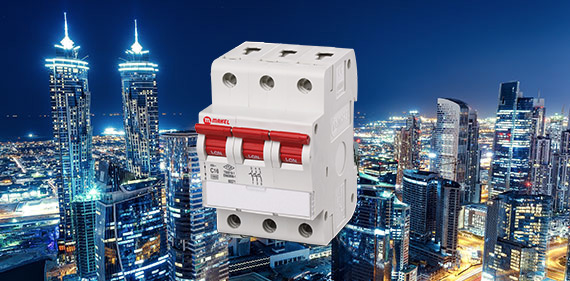
To guarantee elite operational safety for your primary entrance lines, explore Makel's internationally certified AC Type Residual Current Circuit Breakers range.
Key Factors for Proper RCD Selection
To achieve uncompromised protection margins while eliminating frustrating "false tripping" events, configure your distribution setup using these core engineering guidelines:
- Pole Configuration: Implement a 2-Pole (2P) configuration for residential single-phase (monofaze) systems, and a 4-Pole (4P) variant for industrial or three-phase (trifaze) network infrastructures.
- Current Waveform Adaptation: While basic AC-type breakers are thoroughly sufficient for resistive heating elements and incandescent lamps, circuits powering variable-speed inverter air conditioners, server racks, and LED drivers require Type A or specialized Type B units to properly detect rectified or pulsating DC leakages.
- Rated Current (In): The maximum continuous current rating of the RCD (e.g., 25A, 40A, 63A) must always be selected to be equal to or one step higher than the nominal rating of the upstream miniature circuit breaker (MCB) protecting that line.
Maintain Your Safety Shield
Residual current devices are the invisible armor surrounding your property's electrical grid. However, to guarantee this defensive mechanism is fully functional, you should press the integral "T" (Test) button located on the faceplate once a month. This test simulates a minor leakage, ensuring the internal release spring drops the toggle switch instantly. Relying on Makel's high-precision low-voltage components keeps your power distribution safe and under reliable control at all times.