

Why Is Smart Home Infrastructure Becoming a Standard in New Generation Housing Projects?
In the modern construction sector, automation networks, which transform structures from passive reinforced concrete masses meeting shelter needs into highly secure digital ecosystems through Internet of Things (IoT) based communication protocols while optimizing energy consumption and autonomously managing climate and lighting scenarios by learning user habits, are moving away from being a luxury hardware level to be positioned as a fundamental engineering rule in all new generation architectural projects. Contractors include this infrastructure in their projects. End users demand energy savings. Interior designers integrate technology into the design. Makel Smart Home Solutions fully meet these expectations. Technology increases the value of buildings. Correct system selection offers long-lasting use.
Digital Transformation in the Construction Sector and Infrastructure Needs
While the valuation criteria of housing projects were previously limited to physical features such as square meter size or location, today they are being reshaped by a comprehensive set of technical parameters ranging from the carrying capacity of fiber optic data buses to the building's ability to manage its own energy and the integration of open-source automation protocols that allow devices from different manufacturers to communicate seamlessly over a common network. Current installation habits are changing. The wiring architecture is redesigned. Electricians include data cables in the system. This transformation begins at the project planning stage. Design errors are prevented at this stage.
Transition from Traditional Wiring to Smart Data Networks
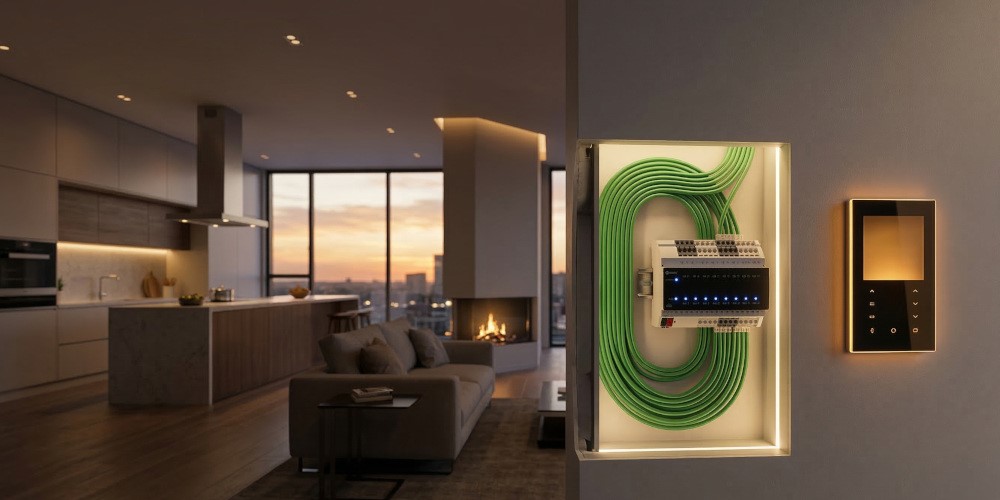
The radial wiring structure in traditional electrical installations, where each switching element directly controls the load and does not offer any scenario flexibility, leaves its place to topologies where sensors and actuators communicate continuously over low-voltage data buses, so that all endpoints from lighting fixtures to motorized blinds can be managed by a central or distributed intelligence. These systems reduce cable clutter. New generation smart home systems offer high data security. Post-installation revisions are made easily. New scenarios are added without physical intervention to the installation. Time and cost savings are achieved.
Energy Efficiency and Sustainability Goals
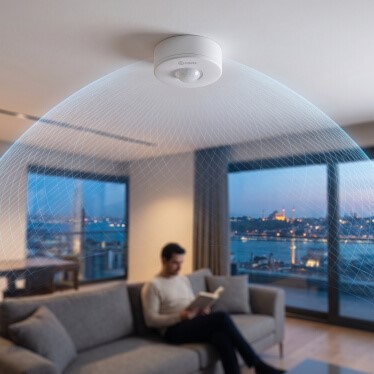
In this period where the effects of the global climate crisis directly change architectural standards, automation setups that minimize resource consumption by instantly analyzing room presence, outdoor light levels, and weather data in order to minimize the carbon footprint of buildings and create a proactive protection shield against changing energy costs are turning into an economic necessity rather than an environmental responsibility for real estate developers. Energy waste damages the budget. Smart buildings use energy efficiently. Green building certificates require these infrastructures. Zero-energy buildings will become widespread in the future. Environmental sustainability goals are achieved.
Heating, Cooling, and Lighting Optimization
In the control of mechanical systems, all components, from magnetic contacts that automatically turn off air conditioning devices if windows are left open to dimming modules that dynamically adjust lumen values to benefit from natural daylight at a maximum rate, are equipped with high-frequency data processing capabilities to continuously balance the comfort parameters of living spaces thermally and visually. Temperature is adjusted separately for rooms. Lighting level is managed with sensors. Unnecessarily running devices are turned off. These features are implemented with smart home products. Makel automation modules maximize savings. The comfort level is always kept at the top.
Changes in User Expectations and Comfort
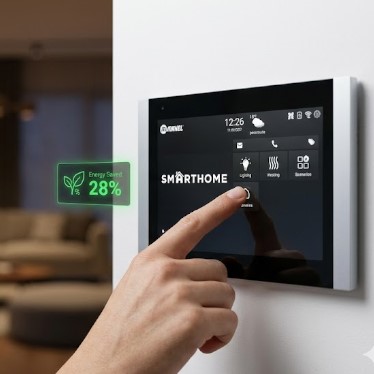
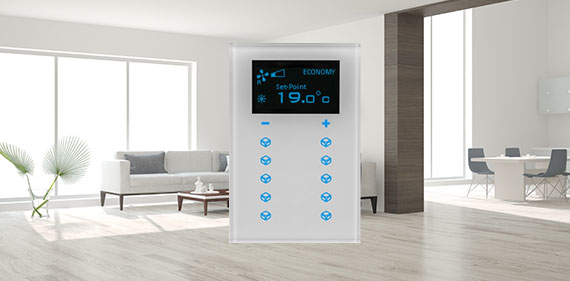
The fact that new generation home buyers, who were born and raised with digital technologies, demand the customizable and fast-responding interface experience on their smartphones in the physical control of their own living spaces directs construction companies to include touch panels, smart devices, and remote-access cloud-based gateways in the default hardware packages of their projects instead of standard switch and socket series. Users monitor their homes remotely. They trigger scenarios from mobile devices. They receive security notifications instantly. Cameras and fire detectors work in integration. The perception of comfort is measured by technology.
Comparison of Traditional Installation and Smart Home Infrastructure
You can review the system comparison below to clarify the technical differences in installation architectures:
|
Installation Feature |
Traditional Infrastructure |
Smart Home Infrastructure |
|
Management Style |
Manual (Physical contact required) |
Autonomous, Remote, and Voice |
|
Energy Efficiency |
Depends on user initiative |
Automatic optimization with sensors |
|
System Flexibility |
Fixed wiring, difficult to change |
Functions changed by software |
|
Security Integration |
Independently operating alarm systems |
Full integration with cameras and sensors |
|
Cable Topology |
220V dense radial lines |
Low voltage BUS and data lines |
|
Fault Detection |
Requires physical measurement |
Digital fault notification and logging |
2026 Construction Vision: Autonomous and Integrated Structures
In line with the upcoming 2026 building regulations and smart city integration goals, systems that can establish two-way communication with solar panels producing their own energy, autonomously adjust the load balance of electric vehicle charging stations on the grid, and have the potential to perform data analysis through advanced automation technologies are transforming residences into active nodes of future energy grids. Highly integrated innovations await us in the future. Homes will manage their own energy autonomously. Biometric sensors will replace physical switches. Systems will detect faults before they occur. Artificial intelligence-supported virtual assistants will optimize the climate and lighting needs of the space instantly. This continuous communication established with smart grids will allow us to reach zero-carbon targets. New generation residences will turn into livable technology centers.