

Data & USB Power Solutions for Smart Homes
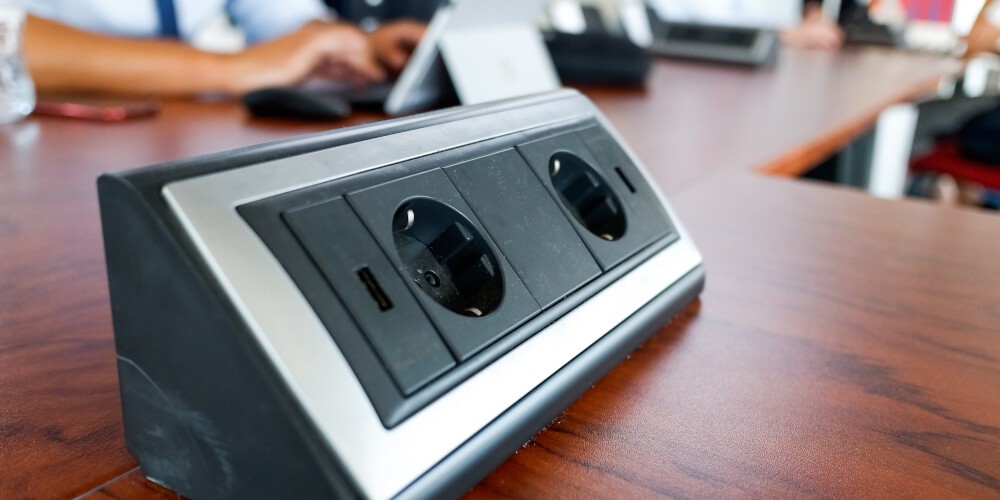
Data & USB Integrated Outlet Technologies: Smart Home and Office Solutions
Today we find ourselves in a world of increasing speed and more wireless technologies — and yet, there seems to be an increasingly greater amount of wire present in our workplaces and homes as well. The latest laptop designs continue to become smaller and lighter, and smartphone battery life continues to increase. However, when looking at our desks and countertops, most of us will likely find a collection of three or four large adapters, a mess of tangled cords and perhaps an extension cord dangling in mid-air like an odd-shaped mountain range. It's at times such as these that data and USB-integrated outlets appear to be quietly filling the void in our lives — providing a solution to a problem that we may have not known existed.
Integrating the functionality of traditional outlets with the ability to connect USB ports directly to the outlet creates a "smart" outlet that provides users with more convenience and safety through reduced cable clutter, improved power delivery and more efficient utilization of available real estate. With these smart outlets, the question remains — "Just how much easier does something so simple make life?"
Below is a closer look at some of the unsung heroes of modern living.
Why Have Integrated USB and Data Outlets Become So Popular?
When the first USB-outlet became available, many people thought, "I already have an adapter." However, as technology evolved rapidly and the number of devices requiring USB power increased exponentially, charging expectations skyrocketed.
The average American household currently has more than 10 USB-powered devices (depending upon individual circumstances), including smartphones, tablets, smart watches, headphones, portable chargers, Bluetooth speakers, etc. All of which require simultaneous charging.
Businesses, particularly those operating in open-office environments, experience an even larger demand. For example, if 30 people work out of an open office environment, approximately 40-50 USB-charging devices will simultaneously be connected to their computers daily. As any IT Manager will attest, this is becoming commonplace.
Therefore, USB-integrated outlets are no longer considered luxury items. Rather, they are practical solutions to real problems that include:
* No more searching for adapters
* Fastest possible charging capabilities
* Reduced cable clutter
* Improved safety regarding electrical usage
* Clean and organized surfaces
Data outlets offer a more permanent and reliable Ethernet connection for businesses that cannot afford to lose productivity due to unstable internet connections.
Types of USB-Integrated Outlets: What Types Work Best?
A USB outlet is simply "a USB outlet." In reality, there are multiple variations of USB outlets, each designed to meet the specific requirements of the user.
USB-A Outlets
Were once referred to as the "standard."
Are still widely available today.
-
Will accommodate most basic devices.
-
Typically offers 5V / 2.1A.
-
May slow down charging of newer phones.
Although still functional, the market is moving toward USB-C outlets.
USB-C Outlets
Current favorites among consumers.
-
Offers faster charging (PD - Power Delivery)
-
Function properly with all modern smartphones and tablets.
-
Can also charge select laptops.
Many builders are now adding USB-C outlets to their new construction projects and placing them directly into the wall.
USB-A + USB-C Combo Outlets
Designed to meet the needs of users who have both older and newer devices.
-
Will accommodate both legacy and modern devices.
-
When both ports are being utilized, the total power output will be split between the two.
-
Ideal for multi-user desks.
Several smart-home contractors state that the combination USB-A/USB-C outlet is a transitional item.
Data Outlets: Why Wi-Fi is Not Always Enough
While Wi-Fi continues to improve, the reliability and consistency of a hard-wired connection remains unmatched. Professionals using large files, video editors, software development teams, and IP phone systems, will appreciate the benefits of having an Ethernet connection.
Ethernet may never be as convenient as Wi-Fi, but its reliability is undeniable. The next time your video call drops or you experience a failed file transfer, you'll understand why Ethernet is so valuable.
What Does a RJ45 Data Outlet Offer?
* Gigabit Ethernet
* A clean aesthetic with in-wall cabling concealed from view.
* Zero drop, reliable connections.
* Excellent performance for demanding applications.
You probably won't realize you need RJ45 outlets until a video call freezes or a file upload fails. At that point, Ethernet becomes every professional's best friend.
Why USB and Data Outlets Matter in Smart Homes
Stable, continuous connectivity is critical to the operation of smart homes. Therefore, reliable power and network access are more important than ever.
USB outlets are found in nearly every smart-home location:
1. Bedrooms and Living Rooms
Most smart-device charging occurs within bedrooms and living rooms.
USB outlets eliminate the anxiety associated with finding an adapter.
2. Kitchen Countertops
As smart kitchen appliances grow in popularity, USB power becomes increasingly valuable.
3. Home Offices
All users have at least one laptop, tablet, and/or smartphone, therefore charging is occurring constantly.
USB-C outlets greatly simplify and streamline this process.
4. Security Systems
Stable Ethernet connections provided by data outlets provide a secure method of connecting IP cameras, NVRs, and routers.
5. Common Areas
Visitors often need charging; the presence of USB outlets eliminates the chaos and creates a more... civilized experience.
Why Power Ratings Are More Important Than Most People Believe
When viewing a USB outlet, do not evaluate the aesthetics first -- instead evaluate the wattage rating.
Most modern smartphones now support 20W fast charging, while some devices can accept up to 30W, 45W, and even 65W fast charging.
Side note: Some manufacturers list high wattage ratings, however, the actual delivered wattage is typically lower than advertised.
USB-C outlets that utilize PD (Power Delivery) represent the safest option.
Regarding the data-side of things, Cat6 or Cat6a cabling behind RJ45 outlets is the preferred choice for most residential homes. Cat6/Cat6a cabling allows for speeds in excess of 1 Gbps, thus eliminating video call lag and large-file download frustration.
Why Offices Benefit Even More From Integrated Outlets
Offices face more aggressive use-case scenarios than residential environments because dozens of people are sharing the same physical space.
- Cleaner Desks
Wireless mice, keyboards and headsets all need constant charging, and placing USB outlets near the user's workstation greatly minimizes clutter.
- Easier IT Management
Reducing the complexity of cable management greatly decreases the number of potential points of failure for IT personnel.
Ethernet reduces Wi-Fi congestion and improves overall system performance.
- Better Meeting Rooms
By concealing cables, the entire ambiance of a meeting room is greatly enhanced and becomes more premium.
- Safer Power Distribution
Low-cost adapters are prone to failure or overheating, and good quality, integrated USB outlets eliminate this possibility.
USB + data + traditional power represents the de facto backbone of modern offices.
Installation, Placement and the Small Details That Matter
Homeowners underestimate the importance of placement for USB outlets. However, choosing the optimal placement can greatly enhance the usability of the outlet.
Placement Tips
* USB outlets should be easily accessible.
* Data outlets should follow the layout of your modem/router.
* Kitchen outlets must be placed above splash zones.
* Bedroom locations should include at least one USB-C outlet located near the bedside.
* Office placement should consist of vertically-aligned outlets at desk height rather than on the floor.
Poorly-placed outlets can create an otherwise beautiful room into a frustratingly inconvenient space.
Energy Efficiency: Small Savings Add Up to Large Impact
USB outlets are extremely energy-efficient and consume minimal standby power.
In large commercial buildings, this minor difference adds up to significant cost savings.
Additionally, high-quality charging circuits prevent excessive heat generation during charging cycles, thereby extending the lifespan of rechargeable batteries. While this may seem insignificant to the average person, extended battery health significantly impacts the long-term viability of electronic products.
FAQ (Frequently Asked Questions)
Do USB outlets damage device batteries?
A high-quality USB-C PD outlet is often more stable than many cheap adapters. Poor-quality USB outlets, however, can be harmful.
Is it safe to charge a laptop from a USB-C wall outlet?
Yes, as long as the outlet provides at least 45W–65W.
Lower wattage will be too slow or may not charge at all.
Can data outlets fully replace Wi-Fi?
Not fully. They’re a perfect complement. Ethernet boosts stability, Wi-Fi provides mobility.
Are USB outlets essential in new homes?
Not essential, but incredibly practical. A bedroom and living room with USB-C outlets make daily life easier.
Do offices still need Ethernet outlets?
Absolutely. File transfers, calls, and overall network performance are significantly more stable.
A Final Thought
If you’re constantly searching for chargers, sharing adapters, or muttering at Wi-Fi dropouts… maybe it’s finally time to upgrade those walls a bit. It’s amazing how much comfort a single well-placed outlet can bring to a space.