




Why is Accuracy Class So Critical in Panel Measurement Systems?

Why is Accuracy Class So Critical in Panel Measurement Systems?
Energy costs constitute a large portion of total expenses in industrial facilities and commercial buildings. Businesses invest in energy monitoring systems to control consumption. However, there is a frequently ignored detail in these investments: Measurement instrument accuracy class. A device with the wrong accuracy class produces erroneous data. This situation leads to incorrect billing and undetected energy losses. Correct measurement is the foundation of savings.
Energy managers often focus only on the brand or price of the device. However, expressions like "Class 0.5", "Class 1", or "Class 3" in technical specifications directly affect the profitability of the business. This guide explains the impact of accuracy class on costs and the correct selection criteria in technical language.
What is Accuracy Class?
Accuracy class expresses the maximum permissible error margin of a measuring instrument. International Electrotechnical Commission (IEC) standards define these classes. For example, a meter with a Class 1 label may have a 1% error in the measured value. Class 0.5 has a 0.5% (five per thousand) error margin.
The numbers may look small. However, for a facility consuming energy at the megawatt level, a 1% deviation means thousands of Liras in uncertainty at the end of the month.
Wrong Class Selection and Hidden Costs
Using a low-precision (e.g., Class 3) device at the main distribution panel is a strategic error. The device shows consumption as less or more than actual.
Billing Inconsistencies: The total of the main grid meter and the internal sub-meters does not match. The facility manager thinks the difference is "loss/leakage". However, the problem is entirely a measurement error.
Wrong Improvement Decisions: Bad data causes bad analysis. An energy manager may think an inefficient motor is "efficient" or vice versa.
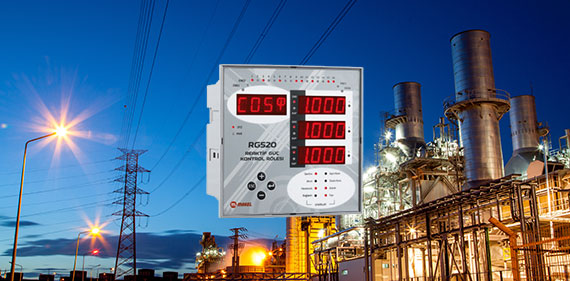
Penalty Risks: If the reactive power control relay does not measure with sufficient precision, the compensation system activates late. The business exceeds the reactive penalty limit.
Precision is Mandatory to Detect Energy Leaks
Energy analyzer sensitivity is the determining factor in finding the location of leaks. Cable heating, harmonic distortions, or loose connections lead to energy loss. Devices with high accuracy class catch even the smallest changes in current and voltage. Low-class devices perceive these details as "noise" and do not report them.
Which Class Should Be Used at Which Point?
Not every measurement point requires the same precision. The location and task of the device determine the cost-effective system. The table below shows the correct strategy for panel meter selection.
|
Application Area |
Recommended Accuracy Class |
Why Choose This Class? |
|
Main Distribution Input |
Class 0.5s or Class 0.2s |
Lowest error margin is necessary for billing verification and main consumption tracking. Large powers are measured here. |
|
Critical Loads (HVAC, Presses) |
Class 0.5 or Class 1 |
Precise data is essential to calculate production costs and perform efficiency analysis. |
|
Lighting / Office Panels |
Class 1 or Class 2 |
Consumption is low. Deviations of 1-2% do not significantly affect the cost. |
|
Compensation Panels |
Class 0.5 or Class 1 |
Precise current/voltage tracking is mandatory to avoid exceeding reactive penalty limits. |
Reliable Measurement with Makel Technology
Makel, a pioneer of local production technology, meets the high standards required by industrial facilities. Makel energy analyzers and panel meters operate stably across a wide measurement range.
Why Makel Measurement Devices?
Makel products perform stable measurements even in harsh industrial environments.
Calibration Stability: Does not deviate even during long-term use.
Harmonic Analysis: Reports energy quality by measuring detailed data up to the 31st harmonic.
Wide Product Range: Offers both Class 0.5s precision for main inputs and economic solutions for sub-panels.
Businesses escape energy blindness by using Makel devices. Data becomes clear, and costs come under control.
Right Investment, Definite Profit
Panel measurement systems are like the "cash register" of the business. The scale must weigh correctly to find the deficit in the register. Choosing a low-class device to lower the initial investment cost harms the business in the long run.
Engineers and purchasing managers must clearly specify the accuracy class in project specifications. As 2026 approaches, rising energy unit prices do not accept errors. Review the measurement devices in your facility. Do not just measure, measure correctly.