


Why Do Heating Problems Occur in Electrical Panels and How to Prevent Them?
Electrical panels are the "brain" centers that distribute energy for a building or an industrial facility; however, uncontrolled temperature increases in these centers are one of the most insidious enemies that, beyond reducing system efficiency, shorten equipment life and trigger fire risks that are difficult to compensate for. A "fever" in your panel is usually the most concrete evidence that something is going wrong.
From an engineering perspective, heating is an energy loss caused by increased resistance or current density in the system. This temperature rise is not just a fault but also a serious safety signal. Minimizing these risks with correct diagnosis and timely intervention will extend the operational life of the facility.
Why Do Panels Heat Up? Sources of Invisible Danger
The problem of heating usually does not depend on a single cause; it arises from a combination of mechanical, electrical, and environmental factors. Here are the primary factors increasing the temperature in your panel:
-
Loose Connections (Contact Resistance): Statistically, this is the number one cause of panel fires. Loose screws in terminals or breaker inlets create a high resistance during the passage of current, leading to overheating of the connection point.
-
Overload: Passing more current through a cable cross-section or breaker capacity than it can carry starts a process that forces the limits of the conductor and causes the insulation to melt.
-
Harmonic Distortion: Harmonics created by non-linear loads such as drives, UPS units, and LED lighting create an unexpected heating load, especially on the neutral conductor.
-
Inadequate Ventilation and Dust: If there is no air circulation to expel the heat inside the panel, the ambient temperature rises rapidly. Accumulated dust, on the other hand, forms an insulating layer on the components and prevents natural cooling.
Prevention and Cooling Strategies
Solving heating problems requires deeper planning than just installing a fan. The following strategic steps should be followed in professional facility management:
1. Periodic Torqueing and Thermal Imaging
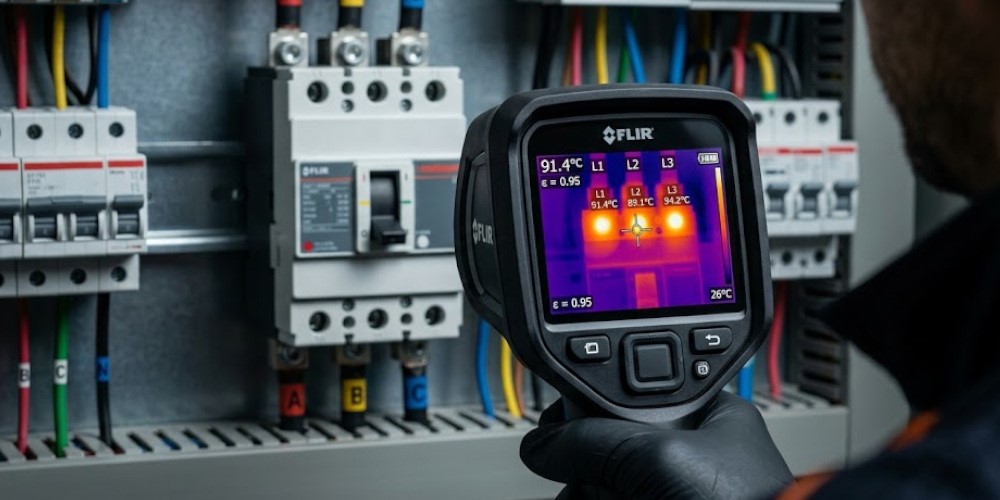
Tightening connections at appropriate torque values (torqueing) at certain intervals prevents arcs caused by looseness. The most effective diagnostic method is thermal camera measurements performed while the panel is under load. In this way, "hot spots" that are not visible to the naked eye can be easily detected before any smell or smoke occurs.
2. Correct Ventilation and Air Conditioning
Fan groups should be installed to provide fresh air intake from the bottom and hot air exhaust from the top to expel the hot air inside the panel. In facilities where the ambient temperature is very high or the dust rate is excessive, panel air conditioners should be used to isolate the internal environment from the external atmosphere.
Heating Problems: Issue - Symptom - Solution Table
You can use the table below as a reference to correctly read the symptoms in your panel and take quick action:
|
Source of Problem |
Physical Symptom |
Technical Solution |
|
Loose Connection |
Blackening or odor in terminal plastics |
Tightening with appropriate torque and using cable ferrules |
|
Overload |
Temperature on the breaker body too high to touch |
Load distribution and checking breaker capacity |
|
Poor Ventilation |
Temperature of the panel door felt from the outside |
Fan installation or panel air conditioner integration |
|
Harmonics |
Vibration and heating in the neutral cable |
Use of harmonic filters or reactors |
|
Inadequate Cross-section |
Hardening and cracks in cable insulation |
Increasing the cable cross-section according to the load profile |
Safe and Cool Systems with Makel
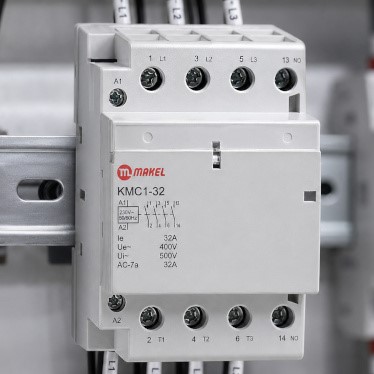
Heating in electrical panels is usually a result of low-quality raw materials and faulty assembly processes. Makel provides the highest level of protection at every point, from industrial facilities to residences, with the professional low-voltage products solutions it has developed to minimize these risks.
The high-heat-resistant polymer bodies and silver-alloy contact structures used in our entire product range, from molded case circuit breakers to miniature circuit breakers, structurally reduce heating at connection points by keeping transition resistance low. Remember; a well-designed panel is not only one that transmits energy but also one that can manage the heat created by that energy.